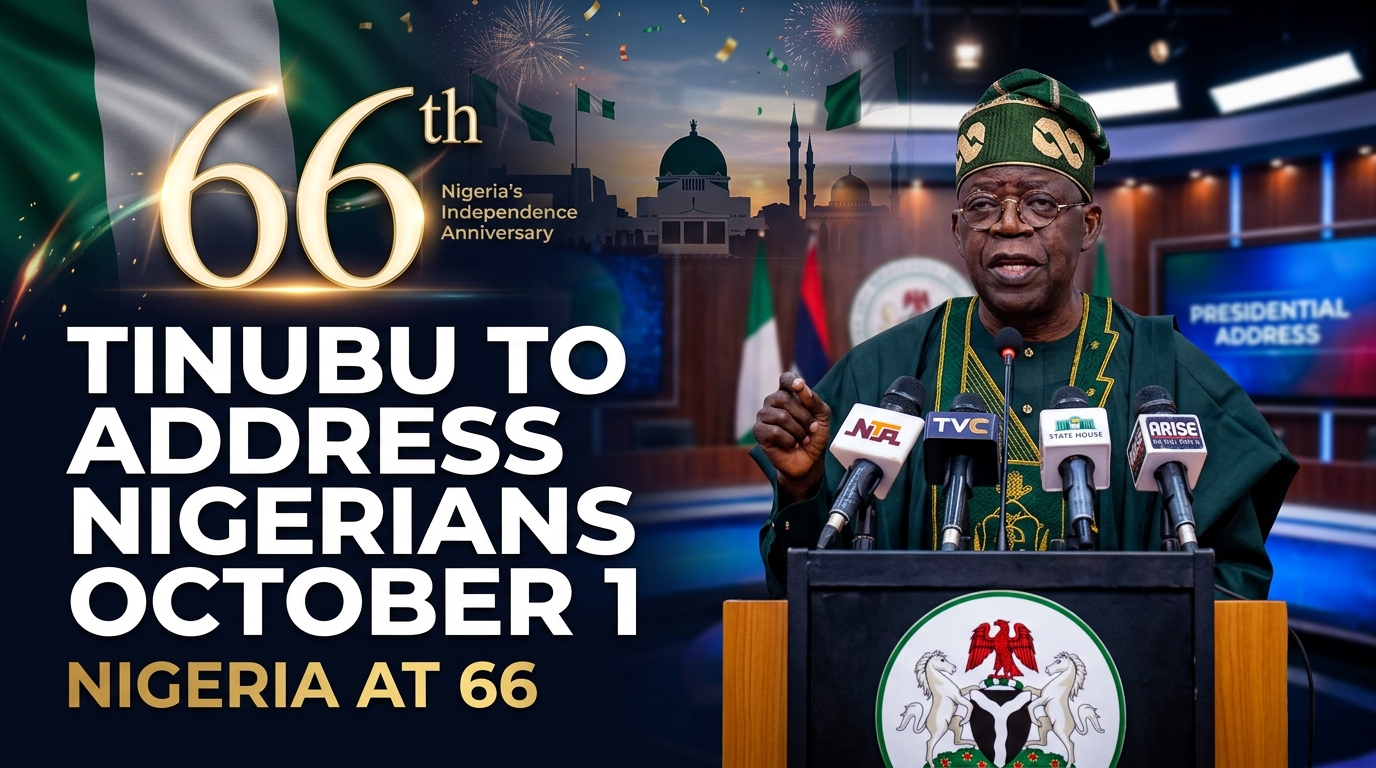
President Tinubu’s Independence Day broadcast is scheduled to be the major event marking Nigeria’s 66th anniversary.
The Federal Government’s Inter-Ministerial Committee, set up to coordinate the celebration, is expected to oversee the activities leading to the president’s address.
According to information released following the committee’s inaugural meeting, the programme will culminate in a nationwide broadcast by Tinubu on October 1.
The address will come at a significant point in Nigeria’s political and economic journey. However, the Federal Government has not yet released the full content or specific subjects that the president will discuss during the broadcast.
That means Nigerians will have to wait until the address itself to hear the president’s detailed message for the 2026 Independence anniversary.
Independence Day broadcasts traditionally provide the president with an opportunity to speak directly to citizens about the country’s journey, current national circumstances and the government’s plans. Tinubu also delivered a nationwide Independence Day address in 2025, when Nigeria marked its 65th anniversary.
Nigeria prepares for its 66th Independence anniversary
Nigeria became independent from British colonial rule on October 1, 1960. The 2026 celebration therefore marks 66 years since the country attained independence.
Over the decades, Independence Day has become an important national occasion, providing an opportunity to look back at the country’s development while also considering the challenges and expectations surrounding its future.
This year’s anniversary committee has been asked to organise activities around the October 1 celebration and ensure that the approved programme is implemented.
The Secretary to the Government of the Federation, George Akume, who heads the committee, described the anniversary as an opportunity to remember the contributions and sacrifices of the people who played important roles in Nigeria’s independence struggle.
Akume was represented at the committee’s inaugural meeting by Bekearedebo Augusta Warrens, the Permanent Secretary in the Political and Economic Affairs Office.
The committee has also been given responsibility for documenting the activities associated with the anniversary and working with relevant organisations and individuals where necessary.
Federal Government plans a low-key celebration
One of the notable aspects of this year’s Independence programme is the decision to keep the celebration low-key.
Officials have cited the limited time available before October 1 as one reason for the urgency surrounding preparations.
Rather than announcing an extensive programme of large-scale celebrations, the government has outlined a series of events that will lead up to Independence Day and eventually conclude with Tinubu’s nationwide address.
The programme is expected to begin with a World Press Conference on September 24.
A Juma’at Service is scheduled for September 25, followed by a Church Service on September 27. An Independence Day Public Lecture is then expected to take place on September 30, one day before the anniversary itself.
The October 1 broadcast by the president will serve as the climax of the official programme.
While the celebration may be more restrained than some Nigerians might expect, the government says the anniversary remains an important moment for reflection.
What this anniversary means for Nigeria
Independence anniversaries often carry different meanings for different Nigerians.
For some citizens, October 1 is primarily a day to celebrate the country’s sovereignty and national identity. For others, it is an opportunity to assess how far Nigeria has progressed since 1960 and consider the issues that continue to affect everyday life.
Nigeria has changed significantly since independence. The country has experienced major developments in education, telecommunications, infrastructure, financial services, healthcare, manufacturing, aviation and technology.
At the same time, citizens continue to deal with issues including the cost of living, unemployment, insecurity, infrastructure challenges and economic pressures.
These realities make Independence Day more than a ceremonial occasion. It is also a point at which national conversations about Nigeria’s direction tend to receive renewed attention.
The Federal Government has said the 66th anniversary will provide an opportunity to highlight the administration’s reforms and efforts to address some of the socio-economic difficulties facing the country.
Tinubu’s last Independence address
Tinubu’s upcoming October 1 broadcast will not be his first Independence Day address as president.
In 2025, when Nigeria marked its 65th Independence anniversary, the president used his national broadcast to discuss the country’s economic situation, government reforms, security, youth development and other national issues.
During that address, Tinubu acknowledged that some of the government’s economic measures had created difficulties for citizens while arguing that the administration’s reforms were intended to create a stronger economic foundation.
He also discussed developments in areas such as oil production, foreign exchange, infrastructure, education and social investment.
The 2025 speech provides some context for the type of issues that have featured in the president’s previous Independence Day communications. However, there is currently no official confirmation of the exact topics that will dominate his 2026 speech.
That distinction is important because the president’s upcoming message should not be confused with statements made during the previous year’s anniversary address.
Nigerians await the president’s 2026 message
With October 1 approaching, attention is likely to turn toward the president’s message and the issues he chooses to highlight.
An Independence Day broadcast gives the president a national platform to communicate directly with Nigerians across the country and abroad.
The speech will also come as the government continues to implement its economic and other policy measures.
Whether Nigerians will hear new policy announcements, updates on existing programmes or a broader message about the country’s direction remains to be seen.
As of September 18, the government has confirmed the broadcast itself and the wider anniversary programme, but the details of Tinubu’s eventual speech have not been made public.
This means that reports claiming to know the full content of the October 1 address before it is delivered should be treated carefully unless they are supported by an official statement.
Independence celebration brings focus to Nigeria’s journey
Nigeria’s 66th Independence anniversary is also an opportunity to look beyond the immediate political and economic headlines.
The country has gone through several important periods since 1960, including military rule, a civil war, multiple transitions, economic changes and the establishment of the current democratic era.
Nigeria returned to democratic rule in 1999 and has since continued its experiment with elected civilian government.
The country has also grown into one of Africa’s most populous nations, with a large young population and an increasingly influential creative, technology and business sector.
Nigerians living outside the country have also continued to contribute to the nation’s economy and international profile through business, entertainment, professional careers and remittances.
Against this background, Independence Day provides a chance to consider both the achievements recorded over the decades and the work that remains ahead.
Committee members to coordinate the programme
The Inter-Ministerial Committee established for the anniversary includes senior government officials from several key areas.
Those involved include representatives from the ministries responsible for finance and the economy, information and national orientation, interior, foreign affairs, the Federal Capital Territory, and budget and economic planning.
The National Security Adviser and presidential advisers are also part of the committee, alongside senior security officials including the Inspector-General of Police, the Director-General of the Department of State Services and the Commander of the Guards Brigade.
The broad composition of the committee reflects the government’s intention to coordinate the anniversary across several ministries and agencies rather than leaving the programme to a single government department.
The committee is also expected to document the anniversary activities for future reference.
Why October 1 remains unforgettable
October 1 holds a special place in Nigeria’s national calendar because it marks the country’s independence from British colonial rule.
For generations of Nigerians, the date has represented the beginning of a new chapter in the country’s history.
Although the way Independence Day is celebrated has changed over the years, the date continues to provide an opportunity for Nigerians to reflect on their shared national identity.
The 2026 anniversary comes 66 years after independence, with the country still facing the task of balancing its enormous potential with the practical challenges affecting citizens.
For the government, it is an opportunity to communicate its assessment of the country and explain its priorities.
For citizens, the president’s speech will provide an opportunity to hear directly from the administration about its plans and perspective on the nation’s current situation.
What Nigerians could expect before October 1
The official programme announced so far gives Nigerians several dates to watch ahead of Independence Day.
The World Press Conference is scheduled for September 24, followed by the Juma’at Service on September 25 and the Church Service on September 27.
The Independence Day Public Lecture is scheduled for September 30.
The programme will then reach its main national event on October 1, when President Tinubu is expected to deliver his nationwide broadcast.
More details could emerge as the anniversary approaches, particularly concerning the timing and broadcast arrangements for the president’s address.
For now, the confirmed information is that the Federal Government has begun preparations and that Tinubu is scheduled to address Nigerians on Independence Day.
Conclution
Nigeria’s 66th Independence Anniversary will be marked with a relatively low-key official programme, but the president’s national address is expected to remain one of the central moments of the celebration.
President Bola Tinubu is scheduled to speak to Nigerians on October 1, 2026, as the country commemorates 66 years of independence. The address will conclude a series of activities beginning with a World Press Conference on September 24 and continuing through religious services and a public lecture before Independence Day.
The exact issues Tinubu will address have not yet been officially released. Nigerians can therefore expect further details as the anniversary draws closer.
For millions of citizens, the day will represent both a celebration of Nigeria’s independence and an opportunity to reflect on the country’s journey since 1960.
The president’s October 1 message will provide the administration’s own assessment of the nation’s current position and its priorities going forward.
Until then, the confirmed message from the Federal Government is straightforward: Nigeria will mark its 66th Independence Anniversary on October 1, and President Tinubu is expected to address the nation as part of the official celebration.