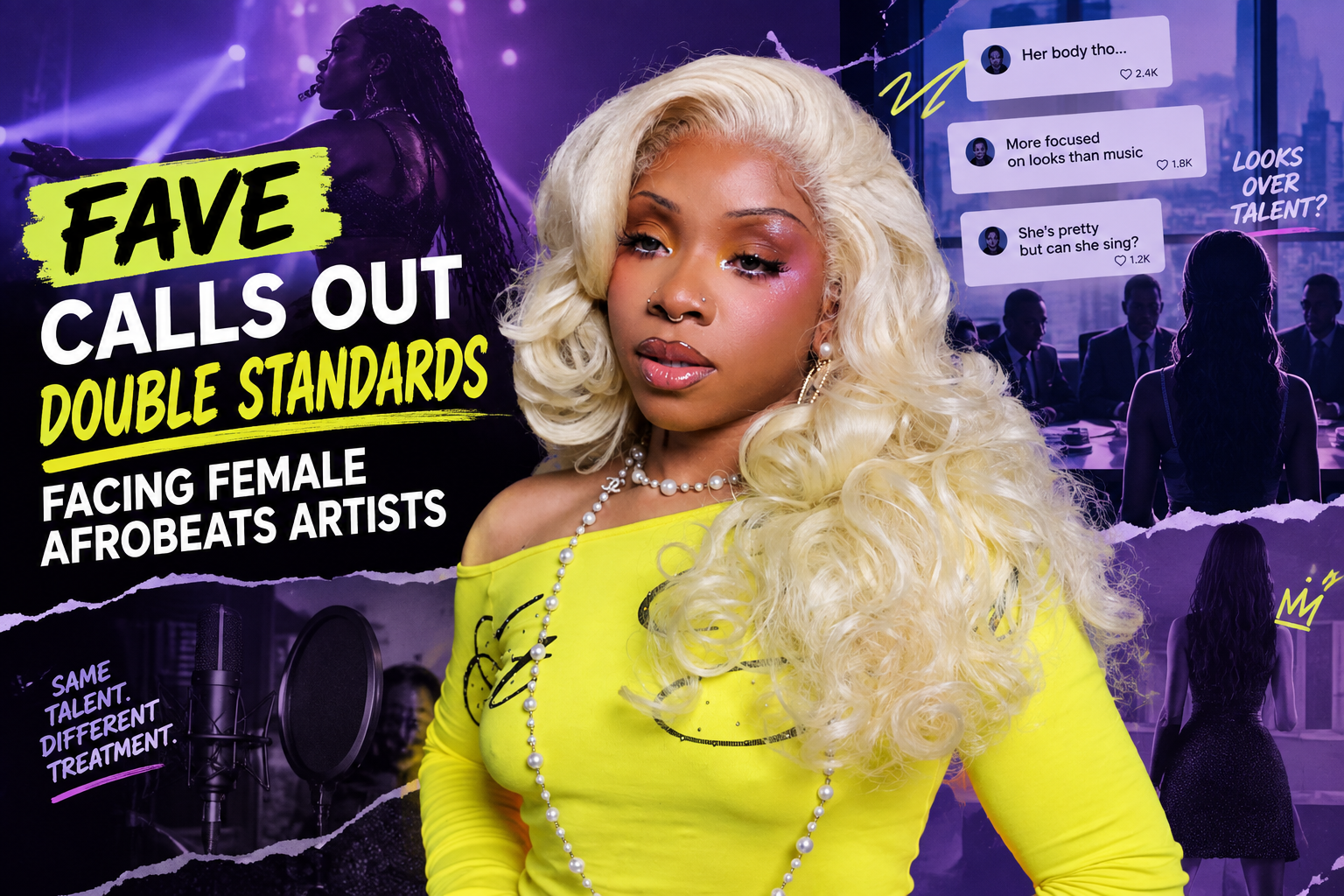
Nigerian singer Fave has opened up about something a lot of female artists in the Afrobeats space have hinted at for years but rarely said this directly in public. Speaking on the Afropolitan Podcast this week, she described a music industry where women are frequently judged on how they look and dress long before anyone actually listens to what they made.
Her comments landed quickly across Nigerian entertainment media, and for good reason. Fave did not frame this as a vague complaint about sexism in general. She got specific about what the double standard actually looks like day to day, from online comments about her body to the pressure she says female artists face just to be taken seriously in rooms full of industry executives.
What Fave Actually Said
On the podcast, Fave explained that female artists in Nigeria’s music scene are held to expectations that have very little to do with their actual artistry. According to her, it is harder for women to break through in the industry because so much of the public conversation around them centers on appearance rather than musical ability.
She pointed out that when people discuss female artists online, the conversation rarely stays focused on the music itself. Instead, she said, attention quickly shifts toward how a woman looks, what she is wearing, and whether her body fits a particular standard. In her view, that shift turns an artist’s public image into something shaped more by other people’s assumptions and fantasies than by the actual work she is putting out.
Fave was also blunt about a comparison that a lot of listeners clearly found relatable. She said male artists in the same industry simply do not face the same level of scrutiny over their appearance, which she believes creates an uneven playing field from the very start. Where men can focus almost entirely on their music and stage presence, she argued that women are expected to manage their image on top of everything else, often without ever escaping questions about how they look.
The Skin Tone Comments That wakes the Conversation
One detail from the interview stood out beyond the general point about double standards. Fave brought up a recent wave of online commentary about her own skin tone, where some social media users speculated that her appearance had changed because she had bleached her skin.
She used that example to illustrate exactly the kind of scrutiny she was describing. Rather than her music prompting discussion, a change in how she looked online became its own story, separate from anything she had released or performed. For Fave, that moment captured the core problem she was trying to describe. The public conversation around a female artist, she suggested, can spiral into commentary about her body and appearance in a way that rarely happens to her male peers, regardless of what she is actually doing creatively.
A Career Shaped By Independence
Understanding why Fave’s comments requires a bit of background on where she has come from in the industry. Born GodsFavour Chidozie, she built her early following by posting freestyles online before eventually breaking through as one of the more recognizable young voices in Nigeria’s Afrobeats scene. Songs like Baby Riddim helped establish her sound, and her collaboration with Davido on Kante brought her further into the mainstream conversation.
For a stretch of her career, Fave was signed to Atlantic Records, a major label with global reach. She eventually chose to leave that deal and continue her career independently, a decision she addressed directly during the same podcast appearance. Rather than framing the split as a falling out, she explained that she wanted more investment specifically directed at marketing her music, rather than simply access to a bigger budget. That distinction matters, since it suggests her frustration was less about resources in general and more about how those resources actually got used to support her as an artist.
Her decision to go independent puts her comments about industry double standards in a slightly different light. She is not speaking as someone on the outside looking in, but as an artist who has experienced the major label system firsthand and made a deliberate choice to step away from it.
The Problem Behind the Scenes
Beyond the public facing scrutiny over appearance, Fave also touched on a more uncomfortable part of the industry that rarely gets discussed openly. She described situations where getting access to studio time or industry connections came with pressure that had nothing to do with musical ability, and she suggested that some executives had expressed hesitation about working with female artists at all because of how those artists might be perceived.
She did not go into extensive detail on the podcast, but the point she was making was clear enough. For many women trying to break into the industry, the barriers are not limited to public commentary about their looks. They extend into private, professional spaces where opportunities can depend on factors that have nothing to do with talent. That combination, public scrutiny on one side and gatekeeping on the other, is part of what Fave described as making it genuinely harder for female artists to establish themselves compared to their male counterparts.
Why This Conversation Keeps Coming Back
Fave’s comments did not appear in isolation. They are part of an ongoing, recurring conversation in Nigerian and broader African entertainment circles about how female performers are treated compared to men, and it is a conversation that tends to resurface every time a well known artist speaks candidly about her own experience.
A few patterns tend to show up whenever this topic comes back into focus.
- Female artists often describe having to work harder just to stay part of industry conversations, even when their output matches or exceeds that of male peers
- Discussions around women in music frequently drift toward appearance, relationships, or personal life rather than staying centered on their work
- Industry gatekeeping, including uncomfortable situations tied to access and opportunity, gets raised repeatedly by women across different genres and generations
- Male artists are rarely subjected to the same public commentary about their bodies or how they dress
None of these points are new on their own, but hearing them from an artist as visible as Fave, delivered plainly and without much hedging, is part of why the interview spread so quickly this week.
Fave’s Response Despite the Challenges
Even while laying out these frustrations, Fave did not present herself as discouraged. She spoke about wanting to support other women trying to build careers in music, and she acknowledged that she is still in the process of growing her own audience and reputation in the industry.
She also made a point of saying she wants listeners to eventually focus on her music itself, rather than everything surrounding it. That framing suggests her goal in speaking out was not simply to vent, but to push back against a pattern she believes actively distracts from the actual work female artists are producing.
What This Means for the Broader Industry
Conversations like this one tend to matter beyond the individual artist raising them. When someone with Fave’s visibility speaks this directly about industry double standards, it often opens the door for other artists, journalists, and fans to weigh in with their own experiences and observations.
It also raises a fair question worth sitting with. If female Afrobeats artists are consistently describing the same set of pressures, from appearance based scrutiny to unequal treatment in professional settings, that pattern says something about the structure of the industry itself rather than any single artist’s individual experience.
Whether this specific interview leads to any meaningful shift in how female artists are covered, promoted, or supported remains to be seen. Industry conversations like this one have come and gone before without producing lasting change. Still, Fave’s willingness to speak plainly about what she has observed and experienced adds another clear voice to a conversation that shows no sign of going away anytime soon.
The Bigger Cultural Moment
It is also worth placing Fave’s comments within the wider cultural moment Afrobeats currently finds itself in. The genre has grown into a genuinely global force over the past several years, with Nigerian and African artists topping international charts, selling out arenas overseas, and drawing collaborations from some of the biggest names in western pop and hip hop. That growth has brought more money, more visibility, and more attention to the industry as a whole, but it has not necessarily solved the internal issues artists like Fave are describing.
If anything, global attention can sharpen the stakes. As more eyes turn toward Afrobeats from outside Nigeria and outside Africa entirely, the way female artists are treated within the industry becomes part of a larger international conversation about representation and fairness in music. Fave’s comments this week are a reminder that behind the chart numbers and viral moments, there is still an ongoing struggle happening for the artists actually doing the work, particularly the women trying to be heard on their own terms rather than through the lens other people choose to view them with.
For now, her interview stands as one of the more candid public statements on the subject this year, and it will likely keep circulating as fans, fellow artists, and industry figures weigh in with their own take on whether anything is actually changing.